Uzbekistan is a country in Central Asia that has undergone significant economic liberalization since President Shavkat Mirziyoyev took office in 2016. It is a doubly landlocked and a lower-middle-income country. The government’s “Uzbekistan 2030” strategy aims to achieve upper-middle income status by the end of the decade through private-sector development, foreign investment, diversification beyond commodities, and WTO accession (targeted for 2026). With a youthful population and abundant natural resources, the country has posted strong growth but faces challenges around job creation, energy infrastructure, and governance reforms.
Geography and Demographics
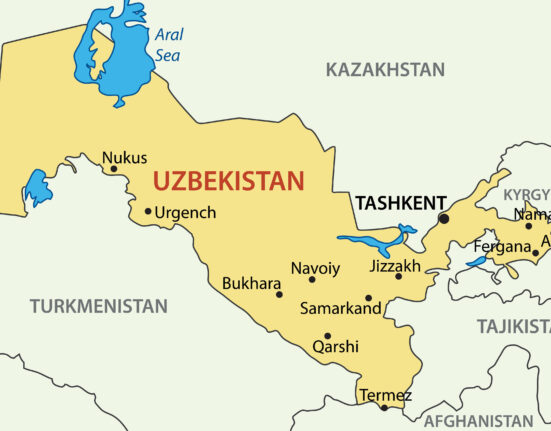
Uzbekistan covers approximately 448,971 km² and borders Kazakhstan (north), Kyrgyzstan and Tajikistan (east), Afghanistan (south), and Turkmenistan (west). It features diverse terrain: deserts (Kyzylkum), fertile river valleys (Amu Darya and Syr Darya), and mountains in the east. Tashkent is the capital and largest city. Population stands at approximately 38 million (2026 estimates range 37.7–38.5 million), making it Central Asia’s most populous nation. It is youthful (median age ~27 years), with urban residency at ~48% and annual growth of ~1.8–2%. Uzbeks comprise ~84% of the population; minorities include Tajiks, Kazakhs, and Karakalpaks. Uzbek is the official language, with Russian widely used in business. Sunni Islam is the dominant religion.
Political Context
Uzbekistan operates as a unitary semi-presidential republic. President Mirziyoyev leads reforms focused on economic opening, anti-corruption, and regional integration (e.g., Organization of Turkic States). The country maintains political stability, though decision-making remains somewhat centralized. International credit ratings have improved (sovereign rating upgraded to BB), reflecting reform momentum.
Economic Review
Uzbekistan’s economy is diversified compared with other Central Asian states. Key drivers include commodities (gold, natural gas, uranium), agriculture (cotton, fruits), textiles, remittances, and emerging sectors such as manufacturing, renewables, ICT, construction, and tourism.
2025 Performance (preliminary/full-year data as of early 2026):
• Real GDP growth reached a record 7.7% (surpassing earlier forecasts of ~6–7%), driven by strong private consumption (+9.5% in H1), investment, net exports, and FDI. Nominal GDP approximated $147 billion.
• Inflation moderated from a February peak of 10.1% to ~8.9% by mid-year (full-year expected ~8–9%), supported by tight monetary policy.
• Unemployment hovered around 4.5–5%.
• Current account shifted to surplus (6% of GDP in H1) thanks to gold/uranium exports and remittances (11% of GDP). International reserves stood at ~$48.7 billion (10 months of imports).
• Fiscal deficit 4% of GDP; public debt remained low (33% of GDP).
Major sectors contributing to growth: gold and mineral exports, industrial projects, agriculture, transport, and renewable energy investments. Remittances and household consumption have been key resilience factors.
Two-Year Economic Forecast (2026–2027)
Consensus forecasts point to continued solid but moderating growth as the economy matures and external risks (e.g., trading-partner slowdowns in Russia/China, global conditions) weigh in.
• 2026: Real GDP growth projected at 6.0–6.6% (IMF: 6.0%; World Bank: 6.0%; Uzbek government target: 6.6%). Nominal GDP targeted to reach ~$167 billion. Inflation expected at ~7.3%, with continued moderation.
• 2027: Growth anticipated around 5.5–6.0% (gradual normalization), with inflation approaching the Central Bank’s 5% target. Public debt projected to stay near 33% of GDP.
Drivers: Robust domestic demand, ongoing FDI and privatization, export diversification, and infrastructure spending. The government plans 1 million new jobs and $50 billion in foreign investment for 2026.
Risks: Geopolitical tensions, slower global growth, energy tariff adjustments (with social mitigation via cash transfers), and potential rises in external borrowing. Upside potential includes higher gold prices and accelerated reforms. Overall outlook remains positive and broadly balanced.
Investment Climate
Uzbekistan has transformed from a closed, state-dominated economy into one of the region’s most attractive destinations for foreign direct investment (FDI). Reforms since 2017 have liberalized currency, trade, taxation, and energy markets while improving transparency.
Key Positive Developments:
• FDI inflows surged: $12 billion in 2024 (nearly double prior years in some periods); government targets $50 billion for 2026. Cumulative foreign investment reached $43 billion+ recently.
• Legal framework: Law on Investments guarantees protection, free fund transfers, and national treatment. New 2024 laws simplify subsoil licensing (mining permits as collateral), privatize SOEs (power, banks, 500+ enterprises), and advance WTO compliance (unified duties, subsidy removals). Energy tariff liberalization and SEZs/IT Park offer tax incentives.
• Institutional support: Investment Promotion Agency, Business Ombudsperson, Foreign Investors’ Council, and one-window registration. Uzbekistan is a member of ICSID and New York Convention for dispute resolution.
• Privatization and competition reforms ongoing (banks by end-2025, major SOEs via IPOs by 2026).
Opportunities:
• Mining (gold, uranium, rare earths, critical minerals)
• Energy (renewables, grid modernization)
• Manufacturing, textiles, agriculture, and agro-processing
• ICT and digital economy (IT Park)
• Infrastructure, tourism (target $20 billion revenues long-term), and transport. Abundant resources, a 38-million consumer market, and young workforce add appeal. U.S. and other investors are active in mining and energy.
Challenges and Risks:
• Residual state dominance in key sectors, case-by-case incentives, and bureaucracy (though improving).
• Corruption perceptions improved dramatically (CPI from 17/100 in 2012 to ~32– 33/100 recently) but still rank mid-tier; judicial independence and enforcement gaps persist.
• Restrictions: Foreign ownership limits in land, airlines, railways, telecom, and security sectors.
• External: Geopolitical volatility and energy shortages during transition. OECD and World Bank note the need for deeper public-governance and systemic reforms for sustainable scaling.
Overall, the investment climate is rated favorably for a lower-middle-income emerging market, with strong government commitment and international support (e.g., World Bank $4.3 billion portfolio, OECD roadmap).
Conclusion
Uzbekistan offers robust growth prospects (6%+ range through 2027) underpinned by reforms, resources, and demographics. FDI momentum and WTO ambitions position it as a rising regional hub. Investors should prioritize sectors aligned with national priorities (energy, mining, export-oriented industry) while engaging local counsel for regulatory navigation. Risks are manageable with continued reform execution. For the latest data, consult the Uzbek Agency for Statistics, IMF, World Bank, or Ministry of Investments, Industry and Trade.
By Bruce H. Gaston, MSc Econ (Lond), ACSI