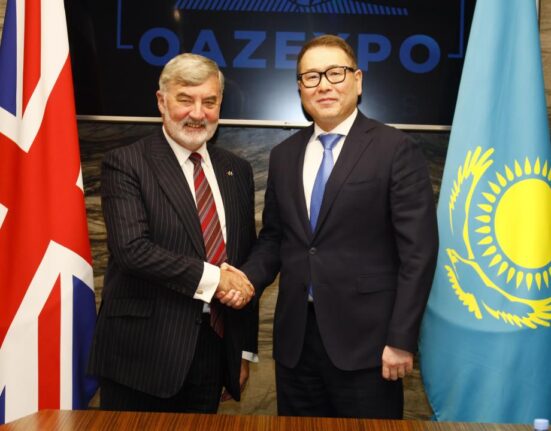

Kazakhstan President Kassym-Jomart Tokayev paid an official visit to Brussels on 23 June and met with António Costa, President of the European Council and Ursula von der Leyen, President of the European Commission.
The leaders welcomed Tokayev’s visit as a strong signal of the growing strategic partnership between the European Union and Kazakhstan at a time of increasing geopolitical importance for connectivity, energy security and resilient supply chains. They reaffirmed their ambition to deepen cooperation under the Enhanced Partnership and Cooperation Agreement (EPCA), that marked 10 years in 2025, according to the Delegation of the European Union to the Republic of Kazakhstan.
The Presidents highlighted the European Union’s role as Kazakhstan’s leading trade and investment partner and agreed to further reinforce the investment climate and strengthen cooperation in strategic sectors, including those under the EU’s Global Gateway strategy for Central Asia, notably critical raw materials, energy, transport, digitalisation and emerging technologies.
They underlined the strategic importance of the Trans-Caspian Transport Corridor and welcomed enhanced cooperation under the EU’s Global Gateway strategy. The leaders welcomed the signing of the Horizontal Aviation Agreement and the successful conclusion of discussions at negotiators’ level on the Visa Facilitation and Readmission Agreements, which will strengthen connectivity and people-to-people ties between Kazakhstan and the EU.
The Presidents reaffirmed the importance of cooperation on critical raw materials and committed to advancing the Roadmap for the implementation of the EU-Kazakhstan Strategic Partnership on Sustainable Raw Materials, Batteries and Renewable Hydrogen value chains. They also emphasised reliable energy cooperation, recognising Kazakhstan’s role as an important oil and uranium supplier to Europe and the potential for stronger cooperation in renewable and civil nuclear energy.
The leaders welcomed strengthened cooperation with the European Investment Bank (EIB) and the European Bank for Reconstruction and Development (EBRD), including the signature of an EIB agreement supporting transport connectivity (€150 million), and an EBRD Memorandum of Understanding for the development of an internationally accredited national chemical-analytical laboratory in Kazakhstan. These initiatives will be implemented in partnership with the EU, in a Team Europe approach. The opening of an EIB office in Astana was further encouraged, as foreseen in the 2025 EU–Central Asia Summit Declaration.
The Presidents welcomed the signing of a certificate agreement between Air Astana and Airbus covering up to 50 A320neo/A321neo aircrafts, worth €7.145 billion, as a tangible example of the deepening EU-Kazakhstan cooperation in aviation, innovation, connectivity, and private sector investment.
The European Union and Kazakhstan on June 23 signed a Horizontal Aviation Agreement. The agreement will enhance connectivity between EU and Kazakhstan by allowing any eligible EU airline to operate flights between Kazakhstan and any of the seventeen EU Member States that do not already have bilateral air services agreements with Kazakhstan permitting such services. It replaces previous restrictions in those agreements that limited these routes to airlines owned or controlled by nationals of the respective Member State or Kazakhstan.
By granting all EU airlines equal access to the market, the agreement promotes open and fair competition, creates new opportunities for passengers and businesses, and provides greater legal certainty for both parties.
Both the European Union and Kazakhstan will now complete their respective internal procedures, after which the agreement is expected to enter into force in the near future.
Photo: EU Delegation to Kazakhstan