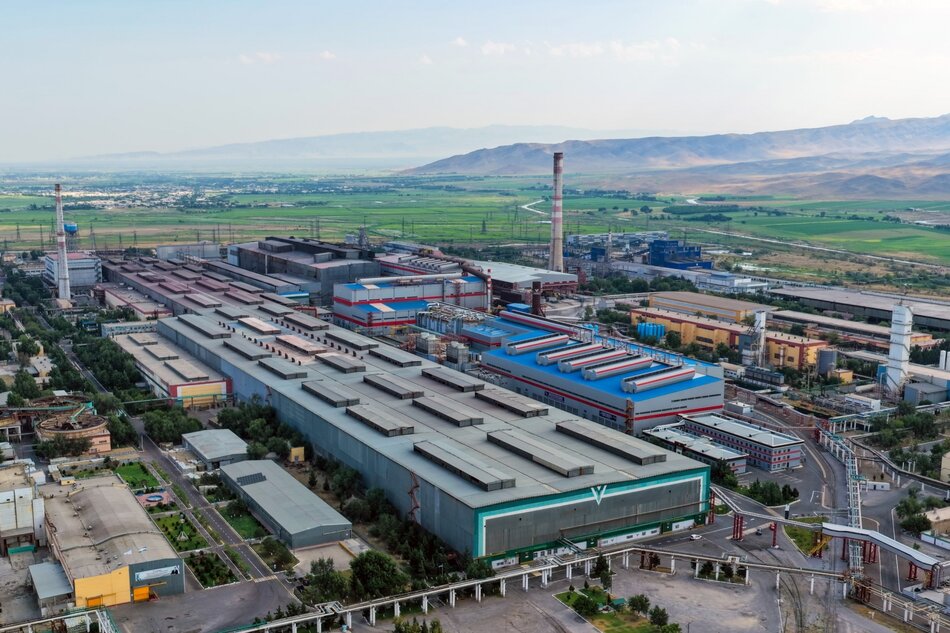
On July 13, President Shavkat Mirziyoyev officially launched a new casting and rolling complex at the Uzbek Metallurgical Plant in the city of Bekabad.
The new casting and rolling complex will go down in history as Uzbekistan’s first facility for the production of hot-rolled steel sheets.
Once fully operational, the complex will produce 1 million tons of hot-rolled steel sheets annually. This will fully meet the demand for sheet metal at the metallurgical plants in Tashkent and Samarkand, while creating 1,200 high-paying jobs.
Mirziyoyev emphasized that the priority task is to meet the plant’s raw material needs through domestic resources. Uzbekistan possesses 1.5 billion tons of iron ore reserves.
Over the next three years, steel ball production lines will be gradually modernized through $30 million in investment, increasing their annual capacity from 250,000 to 500,000 tons.
In addition, the Industrial Park of Ecological Technologies of Uzbekistan will be established on the plant’s territory.
This year, the industrial park will begin implementing six projects worth a total of $70 million for the production of large-diameter pipes, overhead cranes, and filtration equipment.
Mirziyoyev also chaired a meeting at the Uzbek Metallurgical Plant dedicated to the priority tasks for advancing the ferrous metallurgy industry to a qualitatively new stage of development.
The head of state emphasized that ferrous metallurgy is one of the main sources of raw materials for economic sectors with a combined output exceeding $50 billion, including construction, building materials manufacturing, the automotive industry, mechanical engineering, energy, and the electrical industry.
Over the past decades, the country’s demand for flat-rolled products, long products, pipe products, and metal structures has increased threefold, reaching 5.5 million tons. The nuclear power plant, the fourth copper-processing plant, and the new copper smelter currently under construction alone will require approximately 2.5 million tons of flat-rolled products and reinforcing bars.
Over the next five years, new production facilities with a total value of $180 billion will be commissioned, infrastructure projects worth $27 billion will be implemented, and apartment buildings for 800,000 families will be constructed. As a result, annual demand for metal products is expected to increase 1.5-fold by 2030, exceeding 8 million tons.
Currently, the Bekabad Metallurgical Plant produces 40 percent of its rolled steel from recycled scrap metal, while the remaining 60 percent is manufactured using imported raw materials. Although 700,000 tons of ferrous scrap are supplied to the plant annually from across the country, an additional 500,000 tons remain in the shadow economy.
Mirziyoyev noted that the country possesses 1.5 billion tons of iron ore reserves. An agreement has been reached with Chinese partners to establish annual production of 650,000 tons of iron ore raw materials through the processing of ore from the Surun-ota deposit. The President emphasized the need to create capacity for the annual production of up to 1 million tons of steel through the implementation of the Tebinbulak deposit development project, as well as to accelerate the conclusion of an agreement on the annual supply of 700,000 tons of iron ore raw materials from Tajikistan’s metallurgical combine.
Mirziyoyev identified as priority tasks expanding the raw material base for ferrous metallurgy, reducing import dependence, the widespread adoption of digital and artificial intelligence technologies, expanding the production of new types of products, and strengthening cooperation with the private sector.
Photo: president.uz