
Kazakhstan’s state-owned railway operator, Kazakhstan Temir Zholy (KTZ), has secured up to $300 million equivalent in Swiss-franc-denominated financing from the International Finance Corporation (IFC), the Asian Infrastructure Investment Bank (AIIB), and Standard Chartered (SC) for a project aimed at strengthening Kazakhstan’s rail efficiency and increasing its role as a regional transit hub, according to IFC.
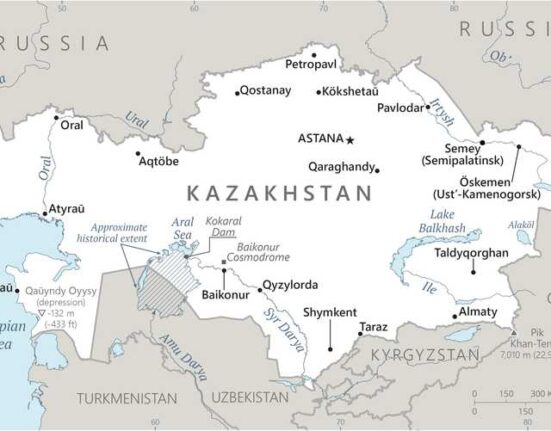
The financing, comprising an IFC investment of up to $50 million, an AIIB loan of up to $150 million, and an SC loan of up to $100 million supported by a proposed guarantee from the Multilateral Investment Guarantee Agency (MIGA), will finance the construction of the 130-kilometer electrified Almaty Railway Bypass.
The project will remove one of the most significant bottlenecks in Kazakhstan’s rail system. The bypass is expected to reduce congestion around Almaty by more than 40%, cut delivery times by up to 24 hours, and improve freight flows along the Trans-Caspian International Transport Route (TITR), also known as the Middle Corridor, linking China and Central Asia to the Caspian Sea and onward to Europe.
According to AIIB, the project includes construction of a new single-track electrified freight railway bypass along the northern perimeter of Almaty. Extending between Zhetygen station in the east and Kazybek Bek station in the west, the route will provide a dedicated corridor for freight operations outside the densely populated city center. The bypass includes construction of new stations and supporting structures such as bridges and overpasses, as well as upgrades at both terminals. A dedicated freight route around Almaty will reduce operational bottlenecks, free up capacity for passenger services and help lower emissions associated with rail congestion.
KTZ Chief Financial Officer Dair Kusherov commented that the Almaty Railway Bypass will be a pivotal upgrade for the company’s network, unlocking capacity and reducing congestion around Almaty. It will enable KTZ to handle growing freight volumes more efficiently and enhance the competitiveness of the Trans-Caspian corridor as a reliable bridge between Asia and Europe.
Photo: KTZ