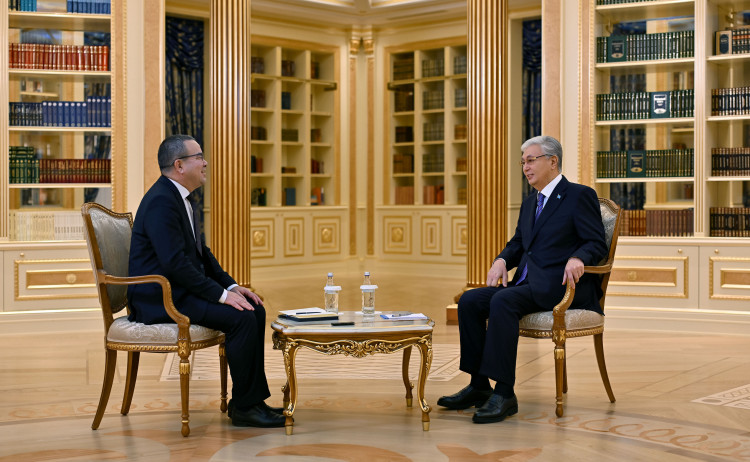
In an interview with the Turkistan newspaper, published on the official presidential website, Kazakhstan President Kassym-Jomart Tokayev said that in 2025, the country’s economy grew by more than 6 percent, with GDP surpassing $300 billion and per capita exceeding $15,000.
“These are record high figures not only for our country but for the entire region,” said Tokayev. “There are reasons to be satisfied, but I constantly urge all government officials to remain resilient and not rest on their laurels. As the Eastern proverb goes, ‘Danger lurks in the most favorable situation.’ We must work hard and move forward, especially since many unresolved issues remain. First and foremost, high inflation is eroding all efforts aimed at improving the well-being of our citizens.
“The government has been tasked with the rational use of budget funds. Flooding the economy with money, provoking inflation, is not an option. Strict budgetary discipline is essential. Financial resources must be directed only to projects that are essential to the state. Last November, the government, the National Bank, and the Agency for Regulation and Development of the Financial Market adopted a three-year program. It is aimed at reducing inflation, which will improve the well-being of citizens.
“International experts correctly believe that Kazakhstan has fallen into a ‘middle-income trap.’ To be perfectly frank, this is not an abstraction from economics textbooks, but a reality that many of our compatriots face literally every day. Income exists, and sometimes considerable, but it dissolves in inflation and obligations—mortgages, children’s education, and parental support.”
According to Tokayev, businesses create jobs and pay their taxes fairly, but expensive loans and limited working capital prevent them from scaling up, entering new markets, and implementing modern technologies.
“The structure of our economy is changing, but at a slow pace. As a result, the country, according to international financial institutions and rating agencies, is prosperous, even wealthy, which is true. However, imbalances within the economy persist that urgently require correction. We will certainly overcome these ‘pains of growth.’ We do have an action plan,” said the President.
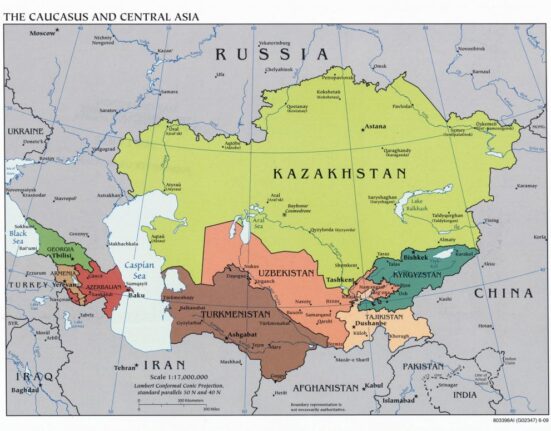
Tokayev emphasized that strengthening the country’s transit and logistics potential is a strategic priority. “Although Kazakhstan is landlocked, it is located in the center of the Eurasian continent at the intersection of most transit routes. This is a significant advantage, which we must capitalize on to the country’s advantage. We have a vision and desire to transform Kazakhstan into a Eurasian transport hub.”
According to Tokayev, Kazakhstan is crossed by 12 international transport corridors: 5 rail and 7 motor road routes, accounting for up to 85 percent of overland freight traffic between China and Europe.
“Our country is actively involved in the development of China’s Belt and Road Initiative megaproject, the North-South Corridor, and the Trans-Caspian International Transport Route, or Middle Corridor. We believe that transportation along the Russia-Kazakhstan-Turkmenistan-Iran route, with access to seaports, is also promising,” the President said.
Commenting on Kazakhstan’s nuclear energy ambitions, Tokayev said that the construction of several nuclear power plants is, on the one hand, a correction of the historical absurdity of being the world leader in uranium production and not building a single nuclear power plant; on the other hand, it is a prestige boost for Kazakhstan.
Photo: akorda.kz