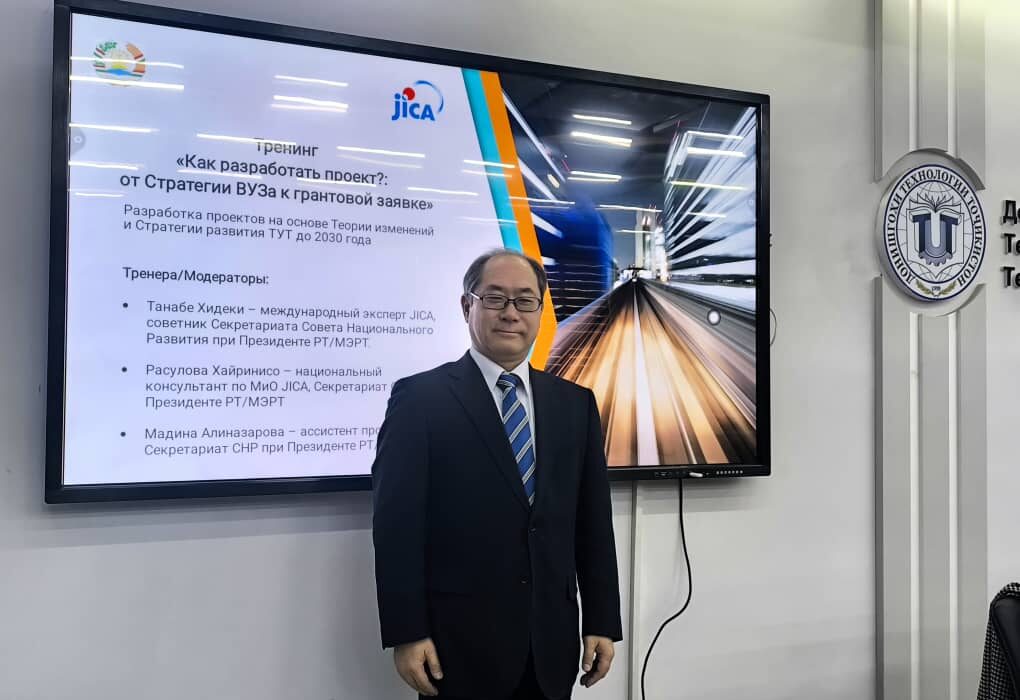
Hideki Tanabe is a senior international development expert who stood at the origins of the Japan International Cooperation Agency (JICA) in Tajikistan. Having completed his tenure as the first Head of JICA’s independent office in the country, which he led since its establishment in 2017, he played a key role in integrating Japanese technical assistance and grant projects into Tajikistan’s socio-economic development.
Under Mr. Tanabe’s leadership, JICA significantly expanded its cooperation with government institutions, implementing projects in healthcare, water supply, agriculture, transport, human capital development, and private sector strengthening. Currently, Mr. Tanabe serves as the Development Management Advisor of the Secretariat of the National Development Council under the President of the Republic of Tajikistan, Ministry of Economic Development and Trade of the Republic of Tajikistan. Here is an interview with Mr. Tanabe:
— Mr. Tanabe, you became the first Head of JICA’s independent office in Tajikistan. Looking back, what is the most important management lesson you learned during your work here?
— The most important lesson is the value of trust at the highest level. From the very beginning of my mission, I focused on meetings with the Deputy Prime Minister, heads of ministries and agencies, as well as representatives of the donor community. My goal was simple but strategically crucial — to build trust between organizations at the leadership level.
In Tajikistan, many key decisions are made precisely at this level. If there is no mutual understanding and agreement between leaders, cooperation simply does not start. Moreover, employees always observe the relationship between their leaders. When they see, for example, that the Minister of Agriculture and the Head of JICA have established a strong partnership and agreed on common priorities, teams at the working level begin to cooperate calmly and effectively. This is why I believe such an approach is the best starting point for sustainable cooperation.
— Let’s go back a bit. Where did you study, and how did your professional path begin?
— I completed a master’s degree in science and technology, specializing in semiconductors — materials used in computer technologies. My work focused on experimental research in this field.
While studying in the United States, during high school, I interacted with students from different countries and realized for the first time how varied the levels of development are across the world. This was a turning point: I understood that I wanted to do not only scientific work but also practical work — to engage with people and contribute to the development of countries that needed support.
— Which country became your first international assignment?
— I began working in Tashkent, Uzbekistan, where I was tasked with opening the first JICA office in Central Asia. I worked there for four years, essentially building the agency’s operations from scratch. Many initiatives launched during that period are still used today as a foundation for supporting the country’s economic development.
— Which projects from that period do you consider most successful?
— One of the key projects was the Japanese Center in Tashkent. It was established to train entrepreneurs — people who wanted to develop their own businesses in the private sector. In addition to business education, the center offered Japanese language courses and organized cultural exchange events.
Today, the center continues to operate and grow. I consider it a good example of how investment in human capital can yield long-term results.
— You spoke of the Japanese Center as a foundation for long-term relationships. Were similar initiatives planned for Tajikistan?
— I really wanted to open a similar Japanese Center in Tajikistan as well. However, at that time, the conditions were not yet suitable. Therefore, as Head of JICA’s office, I chose a different path and focused on developing a project to explore and enhance the business potential of the Tajik people.
This led to the creation of business incubators. The Government of Tajikistan began establishing such structures in Dushanbe and other regions, and JICA partnered in developing and implementing business training courses. The idea was to create a solid foundation — to start at a small scale, help people take their first steps in business, and gradually move to higher levels of entrepreneurship development.
— Recently, President Emomali Rahmon visited Japan. You also took part in these events. Could you tell us about that visit?
— Yes, it was a very important event. For the first time, a summit was held between Central Asian countries and Japan at the level of heads of state and the Prime Minister of Japan. The meeting was hosted by the Prime Minister — the first woman in this position — which attracted significant attention both in Japan and internationally.
This summit marked a culmination of over 30 years of Japan’s cooperation with Central Asian countries. The “Central Asia + Japan” dialogue was launched in 2004 at the level of foreign ministers, but in December, it reached the level of heads of state for the first time. President Emomali Rahmon held bilateral meetings, and numerous speeches focused on furthering cooperation. It was an important event, aimed not only at reflecting on past achievements but also at shaping a joint future.
— You are now working at the Ministry of Economic Development. In your view, what could Japanese and Tajik colleagues learn from each other?
— I have been working in Tajikistan for almost six years, and I can say with confidence that Japanese professionals who come here do not only transfer technology, know-how, and knowledge. They also gain a lot in return — cultural experience, human warmth, and understanding of shared values that bring our nations closer together.
Japanese people enjoy working in Tajikistan, and there are many similarities between our nations — respect for labor, traditions, and collective responsibility. This creates a strong foundation for long-term partnerships.
— Speaking about business, what, in your opinion, needs to change in Tajikistan to make Japanese companies genuinely interested in operating here?
— I believe that the Tajik people are very hardworking and honest in collaboration. This is a great advantage. However, there is one managerial aspect that can still be developed — systematic planning.
Decisions are often made at the leadership level, but it is not always clearly explained why a particular task is carried out and what the intended result should be. People working at the operational level do not always see the big picture and the ultimate goal.
It is important to first clearly develop a work plan: what stages are ahead, which tasks need to be completed, and what outcomes we aim to achieve. Equally important is conducting monitoring and evaluation — understanding how the process is going, what works, and what needs adjustment. All key information should be accessible to stakeholders and available on a unified, clear platform. When there is a clear plan and transparency, work becomes easier for everyone — and this is precisely what Japanese companies value.
— Japanese and Tajik cuisines are very different. Which Tajik dishes have you particularly enjoyed?
— Indeed, the cuisines are very different. In Japan, the diet is centered around white rice and seafood. Japanese cuisine is relatively light, without much oil. In Tajikistan, dishes are more hearty and rich, using more oil and meat — which also has its own charm.
I like that in both cultures, rice plays an important role, even though it is prepared differently. It’s a nice symbol: the traditions are different, but the foundation is understandable and familiar.
— And do you think Tajikistan is attractive for Japanese tourists? What could be done to increase their numbers?
— Japanese people love mountains. About 70 percent of Japan’s territory is mountainous, but the scale is very different. In Tajikistan, where mountains cover more than 90 percent of the country, they are higher, wider, and leave a strong impression. For Japanese people who appreciate nature and tranquility, this is very appealing.
The main challenge is the lack of information, especially in Japanese. Too little is known about Tajikistan. Here, young people could play a significant role — those who can communicate about the country in a modern, engaging way, explain what unique places can be visited, and what experiences are available. If such information becomes accessible and clear, Japanese tourists would come with much greater interest.
— Thank you for the interview and for your contribution to the development of Central Asian countries. Your experience and work help strengthen cooperation between our nations and create a foundation for long-term partnership. Thank you for the conversation.
by Shoira Toirova