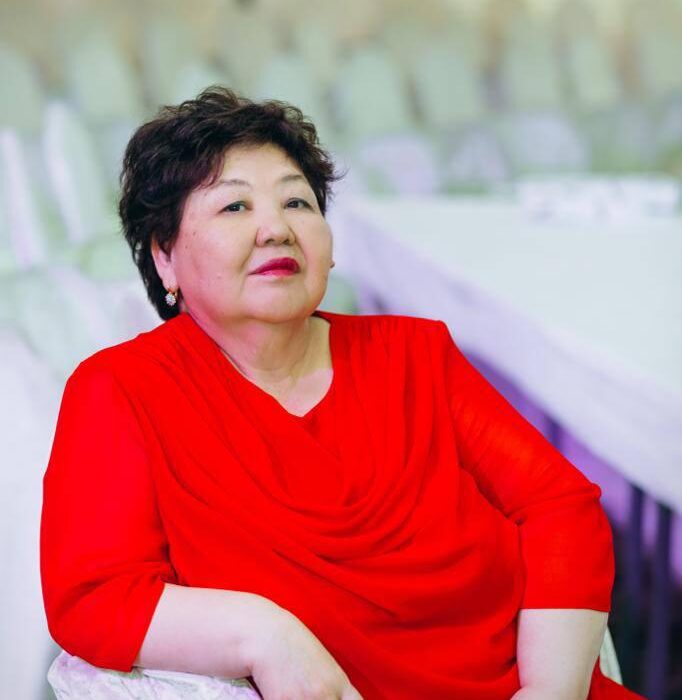
Saltanat Khamzeeva is a remarkable woman who has successfully merged a creative nature with a practical mindset. During a difficult period of her life, it was precisely this combination—talent, inner discipline, and marketing intuition—that helped her not only find her footing and confidence but also forge a path that today allows her to support other creative individuals: helping them find their voice, gain visibility, and improve their financial standing.
Saltanat Khamzeeva is an editor and writer from Kazakhstan. Late in 2025, she was elected Vice-Chair of the Eurasian Creative Guild (London), a non-profit public organization uniting and promoting cultural and artistic figures of the Eurasian region in the English-speaking space.
This interview, prepared by journalist Shoira Toirova, serves as a clear example that in today’s reality, talent and hard work alone are no longer enough. It is essential to know how to build communication, think strategically, and not be afraid to move beyond the local space—reaching toward an international level.
Q: Learning your story, I realized that you are a rare and profound interlocutor whose life can serve as an example for different generations. Allow me to ask a personal question. There was a major turning point in your life—a period you described as a “make or break” situation following the loss of your husband. What was the internal decision you made then to change your life? And how did that experience influence your subsequent path?
S.K.: For me, as for many women, the turning point comes when an enormous responsibility arises. When you are left not only with the pain of loss but also with a very simple and harsh question: how to feed your child and how to go on living.
At such a moment, much in life is re-evaluated. But even in the most difficult circumstances, the need for self-realization—especially creative self-realization—remains inside. It is something that does not disappear, even when it feels like there is no time for creativity.
People cope with this internal tension in different ways: some write memoirs, some turn to science fiction, others to romance novels. Working with words has always been close to me. I wrote poetry and tried to make sense of what was happening through it. But over time, I realized that my strengths lay not so much in poetry as in deeper work with text: with structure, logic, and meaning.
Gradually, it became clear that I always had a need not only to express myself but also to help other authors—those who have a story, an idea, or life experience, but find it difficult to shape it into a cohesive text. Today, we often talk about how an author needs an editor, but back then, that understanding was only just beginning to form.
The turning point was the moment I was first approached with a specific request. It was a man who, during the difficult 1990s, asked me to look at his text—memoirs about the fate of his father, who had gone through Karlag. I took on this work as an editor, and it was then that I realized: this is my path.
From that moment, much changed. I realized I could combine my creative side with the practical side of life: earning a living while staying in my profession, working with texts, and helping people at the same time. This choice defined my entire future trajectory.
Q: You have mentioned many times that you have always been surrounded by brilliant and talented creative people, yet you were the one who managed to distinguish yourself as a strategist and marketer within the creative environment. What was the driving force behind this—character, a professional mindset, or a conscious strategy?
S.K.: First and foremost—character. Stubbornness, the will to survive, and a constant drive to move forward, to never stop, and to keep learning new things. These qualities prevent both the person and their work from stagnating.
The second important factor is a professional foundation. I received a fundamental literary education; I had strong teachers, and this instilled in me a respect for the written word and a deep understanding of text.
Third—environment and practice. While working at a printing house, I went through every stage—from typesetting to proofreading—and later entered a circle of old-school editors. This was a true school of craftsmanship: learning how to work with an author, how to feel the text, and how to understand the value of every single word. I studied them consciously, observing, asking questions, and analyzing every correction.
Over time, I came to an important conclusion: giftedness is a spark given at birth, but talent is giftedness multiplied by labor. Only a person who transforms a gift into mastery can truly fulfill his or her potential. This is where what you call my “marketing approach” comes in. I would call it intellectual marketing—the ability to see the value in a person, help give it a form, strengthen it, and convey it to others. Because marketing is not about selling; it is about understanding the meaning and value.
Q: You mentioned intellectual marketing in literature. Could you elaborate on what you mean by that concept? Is it simply a way to “package” ideas, or is it something more complex?
S.K.: Yes, it is indeed a “packaging of meanings,” but not in a superficial sense. Often, an author possesses a wealth of ideas but doesn’t know how to structure them so they are clear and engaging for the reader. Intellectual marketing is the ability to build a bridge between the author’s complex thoughts and the audience’s perception.
Here, the editor plays a key role as a kind of marketer: we identify the target audience, build the narrative logic, and ensure the book captures attention from the very first pages. In this context, a book is a complete product, but that does not diminish its artistic value. It is simply a modern way for an idea to exist.
It is vital to understand that writing a book is not just about inspiration; it is about discipline. Daily work at the desk, the systematization of thoughts, and constant editing—that is where a true text is born.
Q: Why, in your opinion, is there such a massive boom right now among people wanting to write books? Is it a trend, or a deep-seated human need to preserve oneself and one’s experience in time?
S.K.: That is a very fundamental question. I believe it is, first and foremost, a need of the soul. Humans have always wanted to leave a trace behind. The written word possesses a unique ability to endure through time. Especially when a life is filled with trials and intense experiences, a desire emerges not just to tell one’s story, but to anchor that experience for future generations.
A book is a dialogue with eternity. Through a book, a person overcomes loneliness and the finitude of existence, sharing thoughts and feelings that can resonate with others decades later.
On the other hand, we live in an information age where everyone wants to be heard. In this context, a book becomes the ultimate form of self-presentation: by writing it, a person doesn’t just exist but becomes an author. But the true value of a book is the soul it carries, that which can live in the reader’s consciousness for a long time.
Q: You now hold the position of Vice-Chair of the ECG (Eurasian Creative Guild). You speak about transforming the creative potential of authors, artists, and screenwriters into real market products and supporting their financial and social status. How do you see the balance between commercial success and creative self-expression? And in what way can the Guild’s activities serve not only as production support for individual talents but also as a strategic tool for developing culture, education, and the spiritual well-being of society?
S.K.: The Guild helps its members—whether they are authors, artists, or young screenwriters—to utilize their full talent and turn it into a real product on the market. This is producer work: it is vital that a creative person does not remain poor and socially vulnerable. Supporting one’s economic and financial standing is part of the market logic, where money drives production and economic relations. But creativity is the other side of that same coin. It must retain its value; otherwise, the entire system loses its meaning.
In a practical sense, this means that everything a person creates—books, paintings, films—should, in addition to the joy of the process, bring comprehensive benefits: both moral and material. To write a good book, an author needs health; to have health, they need proper nutrition; to eat well, they need financial support. The Guild’s production function lies in helping creative people generate income and opportunities to build their names—for example, through participation in festivals. We represent authors on international platforms—Dresden, Leipzig, Turkey, Korea, Japan—so they can find sponsors, partners, and an audience.
It is essential for every guild to engage in production activities systematically. This not only supports individual talented people but also creates a cultural strategy that states can notice and integrate into social development plans. If we do not support the creative impulse, if we devalue culture, we risk raising a soulless society and losing the inner world of our youth.
For example, in Ireland, the state provides creative individuals with up to two thousand euros, tax-free, simply so they can pursue their craft. Many would consider this nonsense, thinking that creative people are dependents. But without our national and global cultural figures, without history, we would become a consumerist society without a soul. A person’s inner world must be nourished by creativity; it is the foundation of a society’s spirituality.
Q: Saltanat, you are currently leading an international network. In your opinion, what qualities distinguish a woman leader in the modern world, and what difficulties does she have to face?
S.K.: I believe women leaders possess a special kind of flexibility. This quality allows them to survive and find solutions in complex situations where there seems to be no way out. Women respond more quickly to emotions and know how to account for the feelings of others, which gives them an advantage in team management. At the same time, this can lead to rapid emotional burnout, especially if one fails to maintain a balance between work and personal life.
It is very important to remember that a woman is the center and foundation of the family. If she breaks, everyone around her suffers. Therefore, a woman leader must combine ambition and responsibility with inner peace. I have gone through this myself: there were moments when I wanted to leave everything behind and step into the shadows. But it is precisely the responsibility toward those who believe in you—colleagues, authors, the team—that forces you to get up and keep going.
I believe the future belongs to “soft” leadership: not aggressive pressure, but the ability to listen, negotiate, find meaning, and inspire. This is where the strength of a female executive lies in the modern world.
Conclusion:
Thank you for this inspiring and meaningful conversation. We have heard about the importance of turning creative potential into real results, preserving the value of art in the modern world, supporting authors and young talents, and what a woman leader should be—flexible, attentive to her team, and able to balance work, personal life, and inner peace. I am certain that our readers will find much of value and inspiration in this.
by Shoira Toirova