Days after warning Berlin not to miss the next industrial revolution, the Nvidia chief arrived in Astana talking of a $1tn opportunity.
Jensen Huang arrived in Kazakhstan having just given Germany something of a lecture.
Appearing alongside Chancellor Friedrich Merz in Berlin, the Nvidia founder urged Europe’s largest economy to move faster on artificial intelligence. Germany had the factories, engineering expertise and industrial data, he argued, but little time to waste. “This industrial revolution is so mighty, so powerful,” Huang said. “You don’t have another chance.”
There was a certain irony to the scene. The country that once taught much of the world how to build cars was now being told by a Californian chipmaker how not to fall behind the next technological revolution.
Four days later, in Astana, Huang struck a different note.
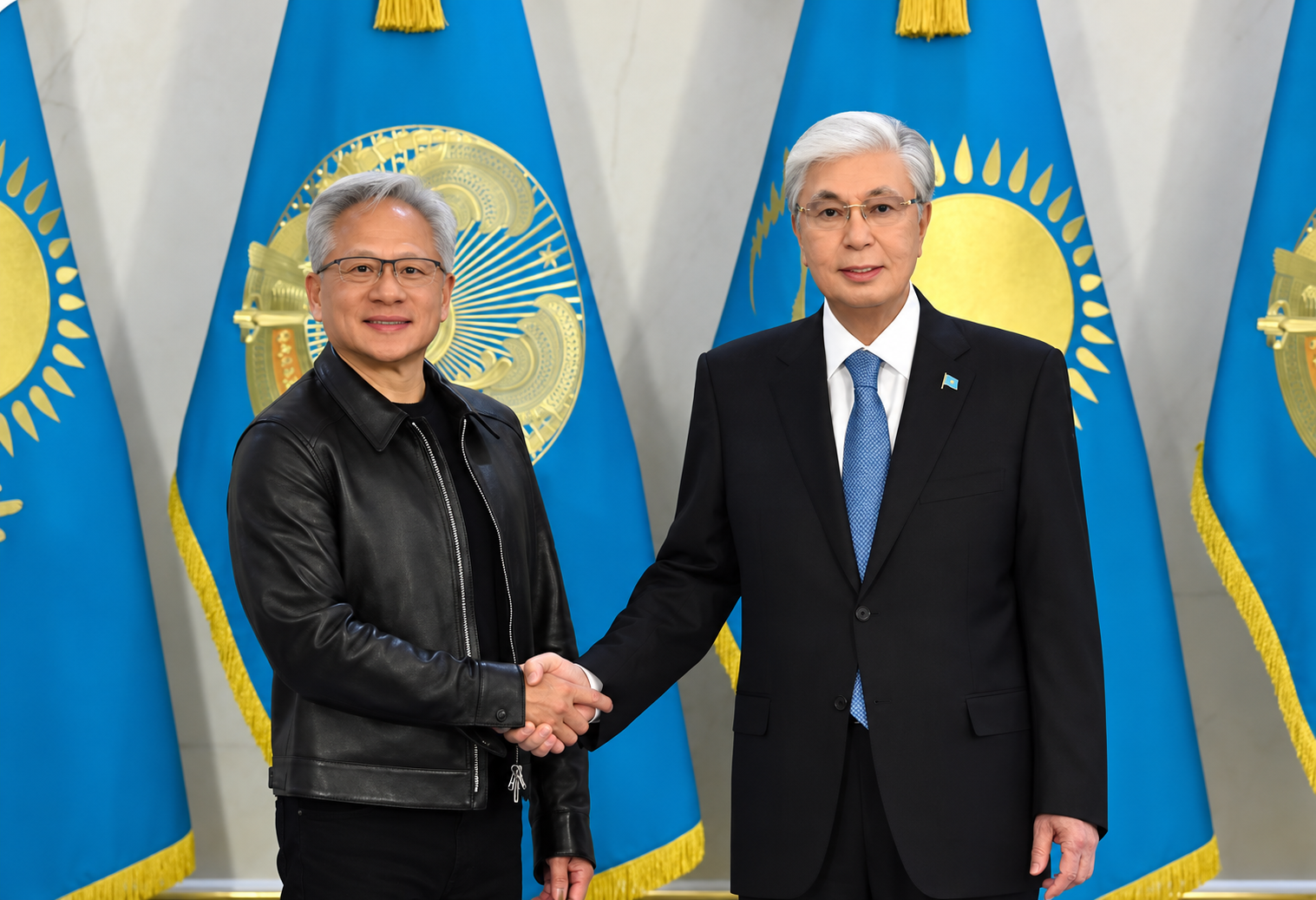
President Kassym-Jomart Tokayev has made artificial intelligence and digitalisation national priorities. Welcoming Huang at the Akorda presidential palace, he said the visit was important in giving “serious impulse” to co-operation with Nvidia and thanked him for his contribution to Kazakhstan’s AI ecosystem.
Huang, in turn, backed Tokayev’s ambition to make Kazakhstan an “AI nation” and proposed that the country become a global hub for Physical AI — Nvidia’s term for artificial intelligence used in robotics, autonomous machines and industry.
The compliments came with large numbers. Speaking about the planned Data Center Valley in Ekibastuz, Huang said each gigawatt of AI computing infrastructure could represent about $50bn of investment. A five-gigawatt cluster, he estimated, would mean $250bn of investment and could generate $1tn in economic activity.
Those figures are projections, not commitments. Kazakhstan has so far signed a $10bn package of AI and digital-infrastructure agreements involving Firebird and Nvidia technology. But Huang’s arithmetic makes clear why the country is attracting attention.
AI needs prodigious amounts of electricity. Kazakhstan has energy in abundance. The proposition is to turn an old-economy advantage into a new one: use domestic power for computing infrastructure and export digital capacity rather than simply raw energy.
Nor is Kazakhstan starting from a digital blank sheet. It ranked 24th out of 193 countries in the UN’s 2024 E-Government Development Index. Digital banking, payments and public services are already embedded in everyday life, supported by a strong fintech sector.
That makes the comparison with Germany less straightforward than the usual story of an advanced Europe and a catching-up Central Asia. Germany remains an industrial and engineering heavyweight, even if parts of its bureaucracy retain an attachment to paper, post and appointments. Kazakhstan has nothing like Germany’s industrial scale, but in everyday digitalisation it has moved quickly.
Huang’s two stops therefore offered a neat snapshot of the AI race. In Berlin, he was telling an industrial giant not to squander the advantages it already has. In Astana, he was discussing how an energy-rich, digitally mature country might turn the AI infrastructure boom into a new industrial advantage.
For once, the lesson in technological modernisation was not travelling only from west to east.