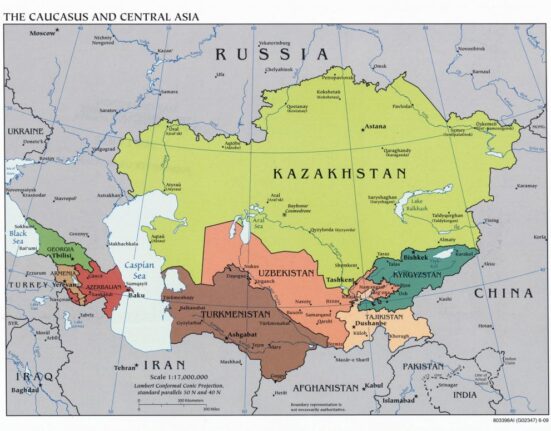

Kazakhstan President Kassym-Jomart Tokayev late in December signed a law ratifying the Agreement between the Government of Kazakhstan and the United Nations Educational, Scientific and Cultural Organization (UNESCO) on the renewal of the status of the Central Asian Regional Glaciological Centre in Kazakhstan as a Category 2 Centre under the auspices of UNESCO for eight years.
The Agreement, which extends the Centre’s activities in Kazakhstan for eight years, was signed in June 2025 by Kazakh Minister of Science and Higher Education Sayasat Nurbek and UNESCO General Director Audrey Azoulay.
Established in Almaty in 2020, the Central Asian Regional Glaciological Centre (CARGC) is the only glaciological centre in the world operating under the auspices of UNESCO. The Centre is mandated to conduct scientific research on glaciology-related issues, coordinate scientific activities and exchange information among various institutions involved in the monitoring of glaciers, snow, and permafrost in Central Asia. This is of particular importance amid increasing glacier meltdown in the region.
According to the Ministry of Science and Higher Education, the CARGC monitors the condition of more than 2,400 glaciers covering a total area of approximately 930 square kilometers. This information is used for scientifically based analysis of water resource changes, forecasting, and decision-making on water and climate sustainability.
The ratification of the Agreement will ensure the continuity of fundamental and applied glaciological research, strengthen scientific support for water resource management decision-making, and expand international scientific cooperation and the participation of Kazakhstani scientists in global research initiatives.
The CARGC’s operation strengthens Kazakhstan’s role as a regional scientific hub in Central Asia and confirms the country’s commitment to international obligations in science, sustainable development, and the rational management of natural resources.