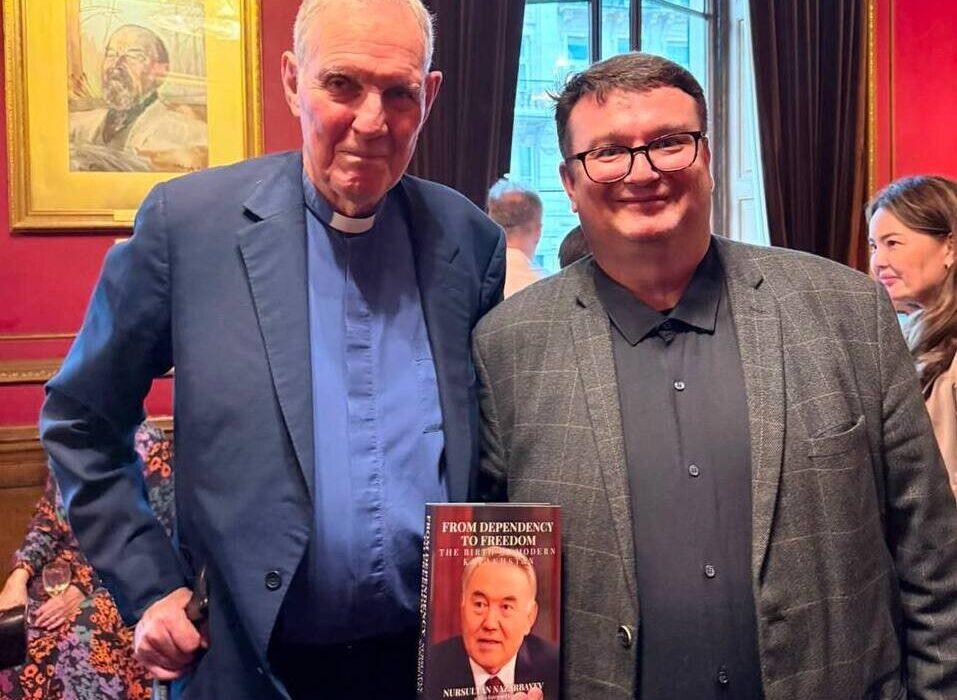
Some events are remembered not only for the book being presented, but also for the people gathered in the room.
It was a pleasure to attend the recent launch of From Dependency to Freedom: The Birth of Modern Kazakhstan, a new biography of Nursultan Nazarbayev, held at the historic Reform Club in London.
London has long viewed Nursultan Nazarbayev with considerable respect. Within British political and academic circles, he is widely regarded as a reformer and a skilled diplomat who guided Kazakhstan through one of the most complex periods of the late twentieth century. The distinguished audience at the event reflected that perception. The evening brought together prominent politicians, diplomats, historians, business leaders and public figures.
The book’s author, Jonathan Aitken, has carried out extensive research, bringing together documents, personal accounts and historical evidence to present a comprehensive portrait of Kazakhstan’s first President and the country’s path to independence. The result is more than a biography; it is a detailed account of the emergence of modern Kazakhstan.
Although Nursultan Nazarbayev himself was not present, he was represented by the leadership of his Foundation and by Erlan Idrissov, a former minister of foreign affairs of Kazakhstan, who participated in many of the historic events described in the book. His reflections added a valuable personal dimension, offering insights from someone who witnessed key moments of Kazakhstan’s diplomatic and political development firsthand.
Public opinion about Nazarbayev’s legacy within Kazakhstan has evolved over the years, which is natural for any statesman of such historical significance. More recently, however, there has been a noticeable shift towards a balanced and pragmatic assessment of his contribution, one that considers the broader historical context rather than the emotions or political climate of a particular moment.
Special recognition should also be given to Max Scott of Nomad Publishing. His publishing house has earned the trust of many distinguished world leaders and public figures to tell their life stories. That reputation has been built through professionalism, editorial integrity and a deep respect for historical accuracy.
For me, it was especially meaningful to return to the Reform Club, a place where history, politics and literature have met for generations. Events like this remind us that books are not only records of the past. They also become an important part of the ongoing international conversation about leadership, history and the future.
Marat Akhmedjanov, the founder of the British publishing house Hertfordshire Press and patron of the Eurasian Creative Guild (London)