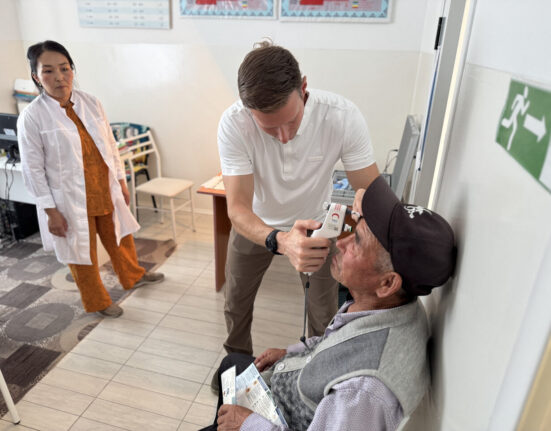

The Central Asian C909 Flying Hospital Mission, organized as part of China’s airborne health Silk Road initiative, was launched in Almaty last week, aimed at bringing high-quality ophthalmic services to medically underserved regions in Belt and Road partner countries.
This is the first such project in Kazakhstan and Central Asia, implemented in partnership between Al-Farabi Kazakh National University, the Eye & ENT Hospital of Fudan University (Shanghai), and the Commercial Aircraft Corporation of China (COMAC), the country’s leading passenger aircraft manufacturer.
The C909 airplane hospital has been modified from a C909, COMAC’s short-medium range turbofan regional aircraft. Instead of rows of passenger seats, the airplane hospital has been transformed into a fully functional ophthalmic surgical suite.
During the launch event, Al-Farabi Kazakh National University and the Eye & ENT Hospital of Fudan University signed a cooperation agreement aimed at developing collaboration in medical education, research, and personnel training.
According to the Kazakh Ministry of Science and Higher Education, a multilateral cooperation agreement in ophthalmology was also signed between China and the Central Asian states.
“The C909 flying hospital mission will give new impetus to cooperation between Kazakhstan and China in medicine, science, and higher education, expanding opportunities for academic mobility, scientific research, and the implementation of innovative medical technologies,” said Bakytzhan Omarov, Member of the Board of KazNU.
The C909 flying hospital is the world’s first specialized airborne medical complex for ophthalmological and otolaryngological care. It is equipped with a modern operating room, telemedicine systems, and artificial intelligence technologies for diagnosing eye diseases. This allows for a full cycle of medical care—from screening and diagnosis to surgical treatment and subsequent rehabilitation.
The airborne health Silk Road initiative is aimed at facilitating the introduction of advanced medical technologies, the development of joint scientific research, and improved access to high-tech medical care for the people of Central Asian countries.
Photo: gov.kz