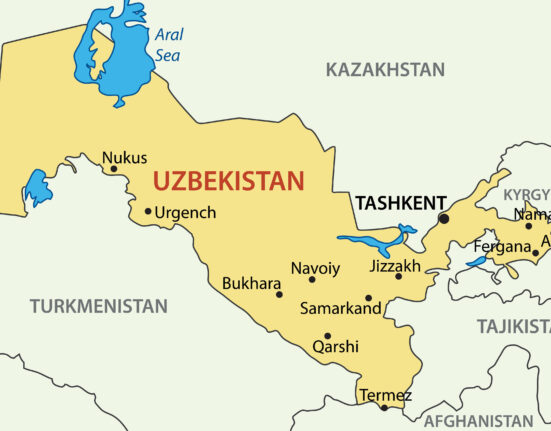
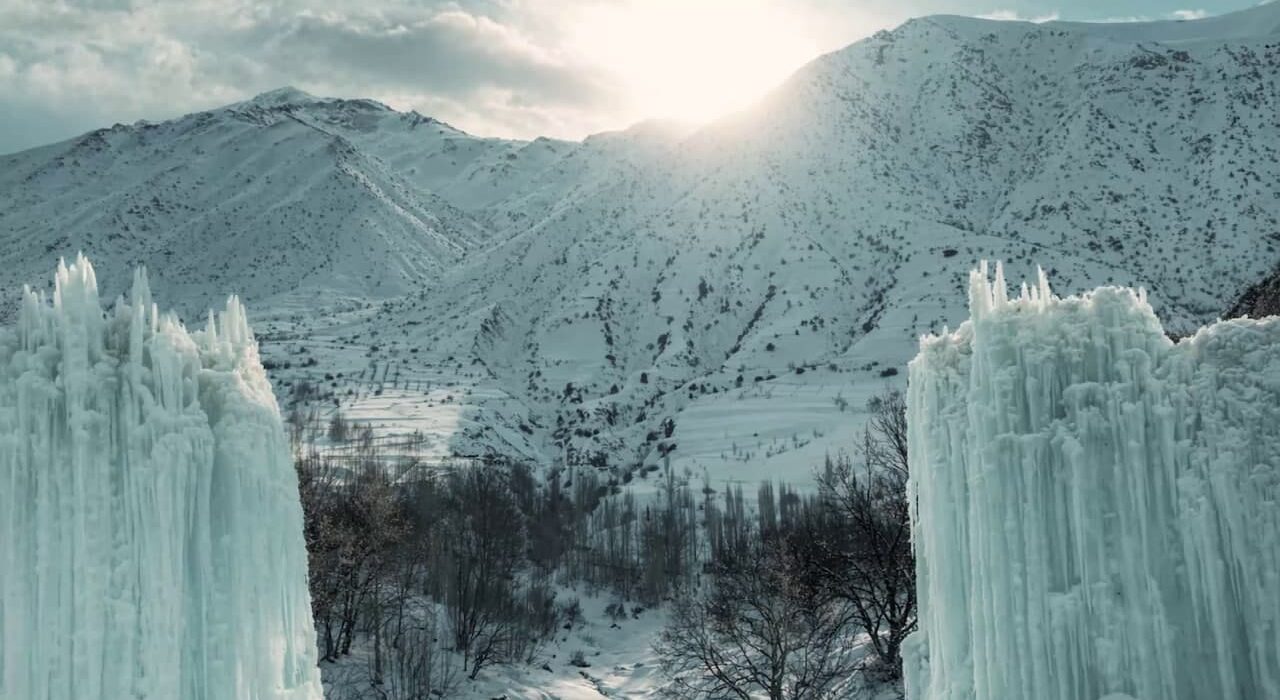
Four artificial glaciers (Ice Stupas) have been created in the Sarchashma mahalla of Shakhrisabz district in the Kashkadarya region. This technology makes it possible to utilize available water resources during the cold season, store the water in the form of ice and gradually melt it in spring and summer for irrigation and household use, according to the National Committee on Ecology and Climate Change of Uzbekistan.
Each artificial ice structure is capable of accumulating an average of up to 450 cubic meters of ice during the winter period, which makes it possible to obtain around 250 cubic meters of usable water in the spring and summer months. This water is intended for early-season irrigation, watering orchards and household plots.
The progress of this pilot project was reviewed by Obidjon Kudratov, First Deputy Chairperson of the National Committee on Ecology and Climate Change, and Sherzod Umarov, Deputy Representative of the Food and Agriculture Organization of the United Nations (FAO) in Uzbekistan.
“In the context of climate change, the protection and effective management of water resources are among the key priorities of state policy. The experience of introducing artificial glaciers in Kashkadarya region represents an innovative and promising approach aimed at reducing water scarcity in foothill areas and creates opportunities for the broader adoption of this practice in other regions of the country,” Kudratov noted.
The initiative is being implemented within the framework of the project “Food Systems, Land Use and Restoration Impact Program in Uzbekistan” (FOLUR–Uzbekistan), carried out by FAO in cooperation with the Committee on Ecology and the Ministry of Agriculture, with financial support from the Global Environment Facility (GEF).
“The artificial glacier technology is one of the practical and effective solutions for climate change adaptation under conditions of limited water resources. This approach enables seasonal water management, supports agriculture, and strengthens sustainable livelihoods for local communities,” Umarov emphasized.
The Ice Stupa technology requires no energy input, is environmentally safe, and is adaptable to local conditions. It is planned to replicate this experience in other foothill and water-deficient regions of Uzbekistan.
Photo: gov.uz