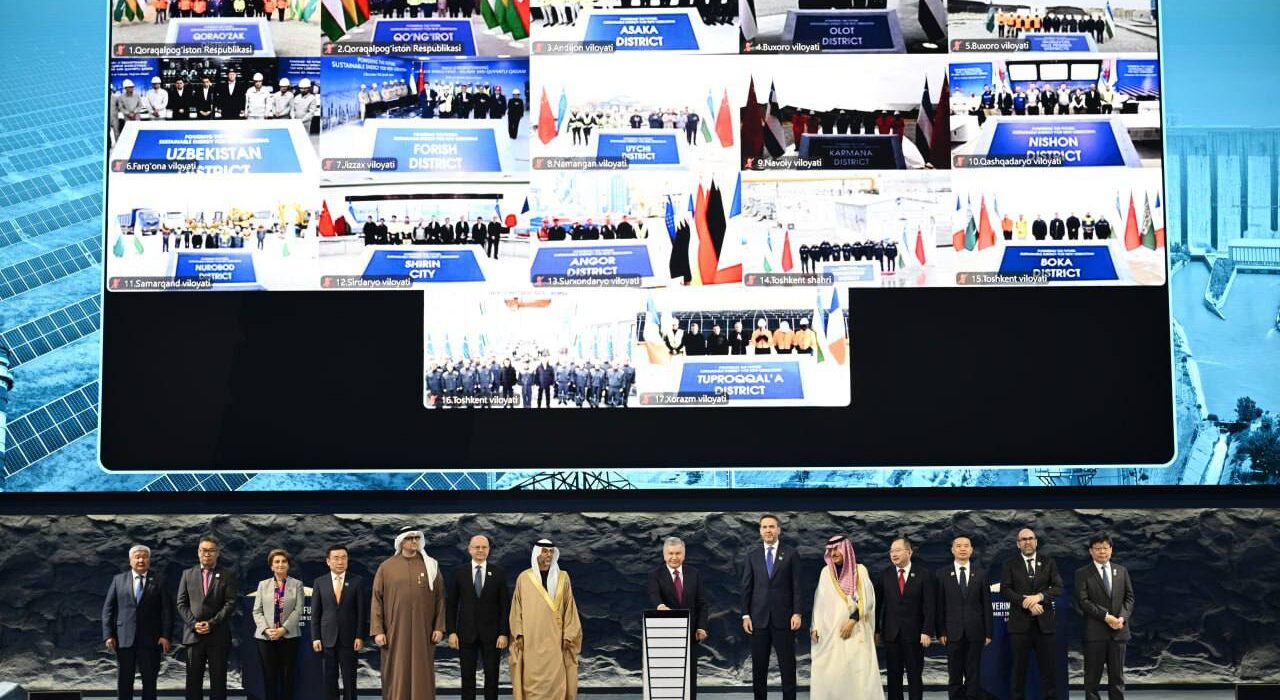
On December 5, President of Uzbekistan Shavkat Mirziyoyev took part in a ceremony marking the launch and start of construction of new energy capacities and infrastructure facilities.
By pressing a symbolic button, the President launched the operation of 42 energy facilities and the construction of 21 new projects.
The event was attended by Minister of Energy and Infrastructure of the United Arab Emirates Suhail Al Mazrouei, Minister of Energy and Natural Resources of Türkiye Alparslan Bayraktar, Minister of Energy of Azerbaijan Parviz Shahbazov, Minister of Energy of the Kyrgyz Republic Taalaybek Ibraev, as well as representatives of the World Bank, the European Bank for Reconstruction and Development, the Asian Development Bank, the Asian Infrastructure Investment Bank, the Islamic Development Bank, and leading companies including ACWA Power (Saudi Arabia), Aksa Enerji, Cengiz Enerji (Türkiye), Masdar (UAE), China Energy, Datang, Sinoma, Poly (China), EDF, Voltalia, TotalEnergies (France), Siemens Energy (Germany), and Nebras Power (Qatar).
42 new generating, storage and production capacities and other energy infrastructure facilities worth $11 billion are a part of the major strategy being implemented in Uzbekistan and aimed at strengthening the potential of the national energy sector.
They include 16 solar, wind, thermal and hydro power plans worth $3.3 billion with the capacity of 3.5 thousand megawatts in Karakalpakstan, Bukhara, Kashkadarya and Tashkent regions.
Once they reach full capacity, these facilities will generate 15 billion kilowatt-hours of electricity per year.
As a result, next year the volume of “green” energy produced in the country will reach 23 billion kilowatt-hours, which will fully meet Uzbekistan’s annual electricity needs.
Most importantly, clean energy will help reduce natural gas consumption by almost 7 billion cubic meters and prevent 11 million tons of harmful emissions from being released into the atmosphere.
Among the projects being launched are 10 energy storage systems with a total capacity of 1,245 megawatts. This will allow to supply an additional 1.5 billion kilowatt-hours of electricity to the grid during peak loads.
Additionally, 11 large substations and 420 kilometers of high-voltage networks are being commissioned, ensuring the stable operation of the energy system.
In recent years, $35 billion in foreign investment has been attracted to the energy sector, and 9 thousand megawatts of new capacity have been commissioned. As a result, electricity production has increased from 60 billion kilowatt-hours in 2017 to 85 billion this year.
Photo: president.uz